Skip to content
Use Case . Healthcare

Cellular Gateway for Remote Patient Monitoring: A U.S. Healthcare Case Study

As the global population ages, the U.S. Remote Patient Monitoring (RPM) and home healthcare industry is experiencing rapid growth. By 2040, the population aged 65 and above in the United States is expected to exceed 70 million. In 2023 alone, about 28% (16.2 million) of seniors were living alone.

Passive RPM is a new generation of monitoring solutions that require no active interaction, wearable devices, or technical operation from elderly users. It has rapidly emerged as a major industry trend due to its seamless and non-intrusive user experience.

A leading healthcare device manufacturer has deployed its flagship “Virtual Care Companion” platform across more than 80% of major healthcare institutions in the United States. The solution utilizes AI-powered, camera-free audio sensors to provide 24/7 behavioral and safety monitoring for seniors living independently.

However, as deployments rapidly scaled into tens of thousands of units nationwide, network connectivity reliability became a critical bottleneck limiting further expansion.

Connectivity for U.S. Home Healthcare Providers

Challenges & Solutions

Traditional home healthcare deployments typically rely on the patient’s existing residential Wi-Fi network for data transmission. In real-world environments, however, healthcare solution providers consistently encounter several major operational challenges.

To address these challenges, GL.iNet partnered with Webbing, a global mobile virtual network provider, to deliver a fully integrated B2B2C healthcare IoT connectivity solution centered around the GL.iNet Spitz (GL-X750V2) Smart Cellular Gateway.

Challenge 01

RPM setups can be complicated

Many elderly users living alone have limited technical knowledge and struggle with complicated home Wi-Fi configuration procedures, including SSID selection and password input. As a result, device activation rates after delivery are often extremely low.

Solution 01

Plug-and-play deployment

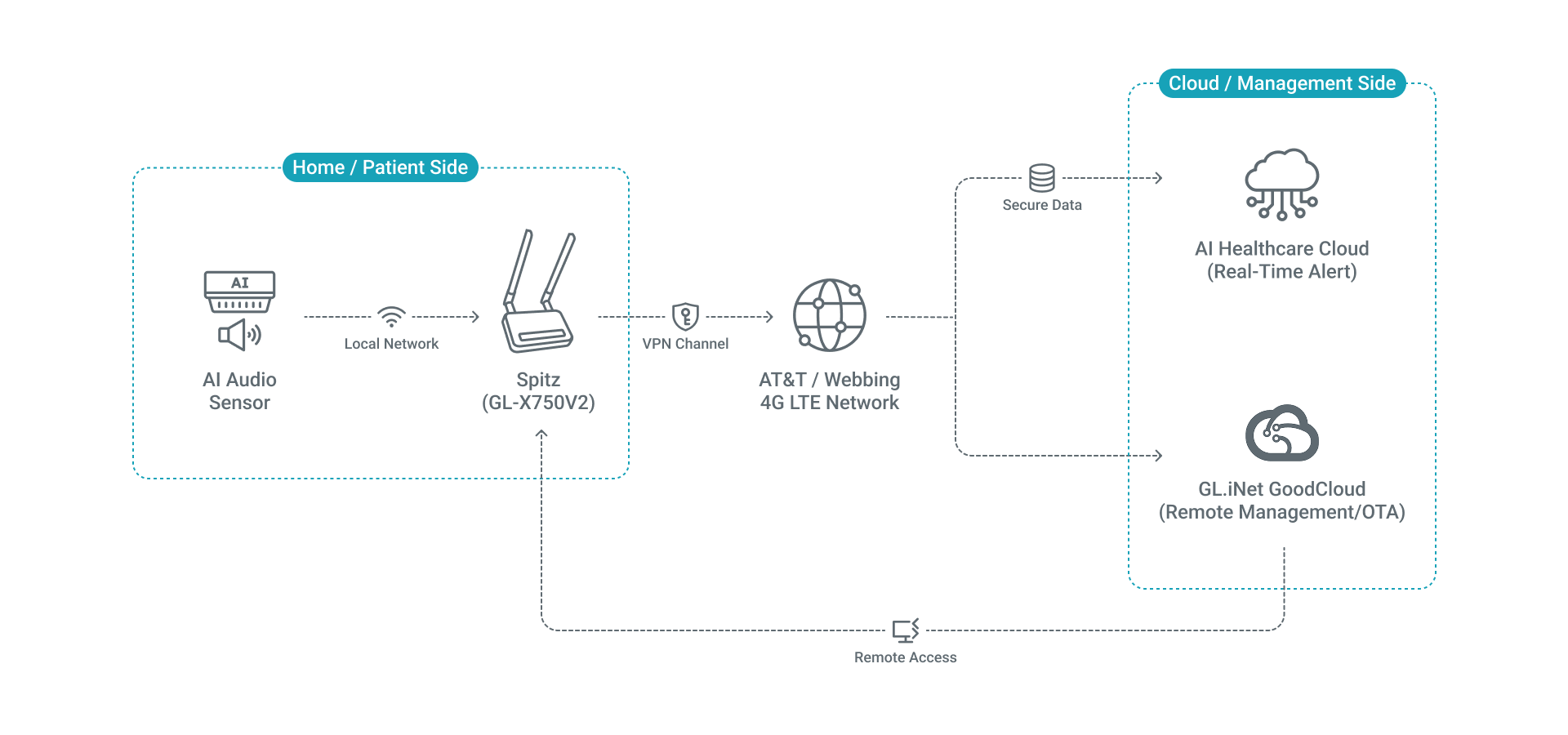
Before shipment, the GL-X750V2 cellular gateway, Webbing SIM card, and AI audio sensor are fully pre-configured, bundled, and delivered directly to the patient’s home as a ready-to-use package. Patients or caregivers simply plug in the device and it’s online and ready to use.
Challenge 02

Unstable networks may interrupt critical alerts

Most healthcare monitoring devices depend entirely on the stability of the existing home internet connection. Once the Wi-Fi becomes unstable or disconnects, emergency alerts (falls, medication errors, etc.) may fail to upload to the monitoring platform, creating serious medical and legal risks.

Solution 02

Carrier-certified reliable connectivity

The GL-X750V2 is officially certified by major North American carriers including AT&T IoT and T-Mobile, with support for multi-carrier redundancy and intelligent failover, ensuring uninterrupted 24/7 connectivity.

Challenge 03

Private in-home data are highly sensitive

Since these monitoring systems process highly sensitive in-home audio data, the entire network transmission architecture requires secure encryption to prevent data leak risks.

Solution 03

Secure VPN connectivity

The gateway comes pre-integrated with OpenVPN and WireGuard VPN tunnels. All environmental audio data is securely encrypted end-to-end from edge collection to cloud transmission.

Challenge 04

Large-scale maintenance is expensive

With tens of thousands of distributed devices deployed across individual homes nationwide, remote troubleshooting, firmware upgrades, and technical support operations become extremely costly and difficult to manage at scale.

Solution 04

Cloud-based fleet management

With GL.iNet’s GoodCloud device management platform, healthcare operators can remotely monitor gateway status across the country in real time, perform large-scale OTA firmware upgrades, and conduct remote diagnostics centrally, dramatically reducing maintenance costs and customer support overhead.

Topology

Results

By adopting the GL-X750V2 solution, the healthcare device manufacturer successfully overcame the final network bottleneck in medical IoT deployment and achieved significant operational improvements.

  • Device activation rate increased to over 95%
    • True plug-and-play deployment allows patients and caregivers to simply power on the device for automatic connectivity, virtually eliminating installation failures, returns, and support complaints caused by Wi-Fi setup issues.
  • Significant reduction in total cost of ownership (TCO)
    • Using the GoodCloud platform, the operations team can remotely manage and troubleshoot thousands of deployed devices nationwide from a centralized headquarters, reducing on-site technical support requirements to near zero.
  • Improved relationship with healthcare organizations
    • End-to-end encrypted connectivity helped the customer build long-term trust with major healthcare organizations across the United States.
  • Strengthened market leadership
    • GL.iNet successfully helped the customer secure a leading position within the passive RPM market segment, while simultaneously increasing GL.iNet’s market share in the U.S. Passive RPM cellular gateway market to 27.5% (based on internal estimates).

Compare products

{"one"=>"Select 2 or 3 items to compare", "other"=>"{{ count }} of 3 items selected"}

Select first item to compare

Select second item to compare

Select third item to compare

Compare